








There's talk of an 'end to the war,' but Indian sailors continue to die
Three Indian nationals died in a US attack on a tanker carrying Iranian oil. Despite the public outrage, New Delhi is keeping a low profile to avoid angering Washington: in the background, a possible meeting between Trump and Modi on the sidelines of the G7. Meanwhile, the White House announced a deal with Tehran. Saudi Arabia reboots trade with Lebanon.
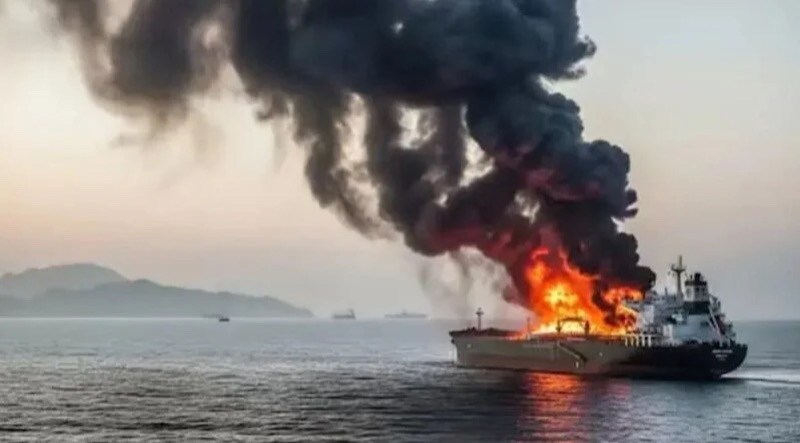
Abu Dhabi (AsiaNews) – The deaths of three Indian sailors in a US attack on an oil tanker have provoked anger and outrage in India, further straining an already tense situation between New Delhi and Washington.
Wednesday morning, a US aircraft fired precision munitions into the engine room of the M/T Settebello, a tanker carrying Iranian oil in the Sea of Oman, one of the most critical places due to the war between the United States (plus Israel) and Iran, setting off a fire with vast plumes of smoke, and a massive rescue operation.
The three men found dead after the attack on the Palau-flagged vessel are the first sailors confirmed to die in a US attack and add to the tragic list of Indian migrant workers killed in the conflict.
The deaths occurred as a result of operations launched by the United States to blockade Iranian ports.
In a statement, the Indian government yesterday reported that some 562 Indian sailors are on Indian-flagged vessels in the region's waters, including 329 in the Gulf region, west of Hormuz, and 233 in the Gulf of Oman, east of Hormuz. Overall, “There are more than 18,000 Indian seafarers in total in the whole Gulf region," the ministry said.
This incident is a major source of concern for the Indian government, which fears that its citizens are increasingly becoming collateral damage in a war that isn't theirs, despite US President Donald Trump’s latest announcement of a peace deal.
Indian migrants have also paid a heavy price in the war, not only in terms of human lives but also in the disruption of daily existence and the loss of income.
AsiaNews has already reported on the plight of hundreds of workers stranded in the region by the conflict, unable to return home to get married, forced to put their wedding “on hold” even if it was already paid.
The US military stressed that the attack came in response to Iran’s repeated failure to comply with instructions given by the same US forces blocking Iranian crude oil exports in the Strait of Hormuz.
Now Delhi, increasingly concerned about the safety of its sailors due to the US-Israeli war with Iran, has urged Washington to halt raids on transport ships. "The attacks that are happening must stop,” Indian External Affairs Ministry spokesman Randhir Jaiswal told reporters yesterday, after the government summoned the US chargé d’affaires.
For Indian Prime Minister Narendra Modi, the incident comes at a particularly delicate time since he is expected to meet with US President Donald Trump on the sidelines of the G7 leaders' summit in France next week.
Modi, who has not publicly commented on the deaths, is under pressure from some unions calling for a strong condemnation of the attack. Most of the 28 sailors aboard the vessel were Indian nationals.
On Tuesday, 24 other Indian sailors had to be rescued from another commercial oil tanker, the M/T Marivex, after it was struck by the US in the Gulf of Oman.
Yesterday, US forces also fired missiles at the engine room of a third tanker, the Guinea-Bissau-flagged M/T Jalveer, which carried Iranian oil, and an Indian crew, who were unscathed with no casualties reported.
The US military strikes against the MT Marivex, MT Settebello, and MT Jalveer near Oman over the past two days have raised concerns and questions about the Modi government's handling of relations with the United States.
These targeted US military actions in the Gulf of Oman mark the only time in India's history since independence that the US military has killed Indian nationals.
The failure by the US military and the US administration to show remorse or apologise for the victims has unleashed popular outrage over the incidents, especially since the US military continues its operations against commercial vessels with Indian crew members, despite protests by New Delhi.
However, neither Modi nor any senior member of his government have uttered a single word of direct condemnation against the United States. The Indian Ministry of External Affairs has carefully avoided naming the perpetrator of the attack, describing the lethal assault simply as "a direct result of the ongoing conflict in the region."
Meanwhile, Washington and Tehran are reportedly in the final stages of talks on nuclear and economic issues, with a draft peace plan set for signature (perhaps) this weekend in Geneva.
It would include the end of the US blockade, the reopening of the Strait of Hormuz, the lifting of oil sanctions, the release of frozen Iranian funds, and a US commitment to withdraw its air forces from surrounding Iran.
The breakthrough came in the last few hours, after Trump announced he had halted air strikes against Iran and had "won" the war, declaring himself satisfied with the objectives achieved and ready to sign the agreement with Tehran.
The ceasefire between the two countries would be extended by 60 days and include Lebanon, with Israeli troops pulling out, a decidedly unexpected turn of events for Israeli Prime Minister Benjamin Netanyahu, who is still pushing for an invasion.
Finally, Saudi Arabia recently decided to end its boycott of Lebanese goods after five years. This marks a turning point for Beirut as the government seek to reduce Iranian influence and reestablish ties with the Arab Gulf countries.
On Wednesday, Saudi Crown Prince Mohammed bin Salman (MBS) announced that Lebanese imports would be allowed into the kingdom, citing "positive steps taken by the Lebanese government toward rebuilding state institutions."
The decision came at the request of Lebanese President Joseph Aoun and Prime Minister Nawaf Salam, who later expressed "gratitude and appreciation" to Prince Mohammed for his "generous" decision to lift the ban, which had contributed to undermining the Lebanese economy.

.png)
04/09/2008
03/12/2019 09:59










