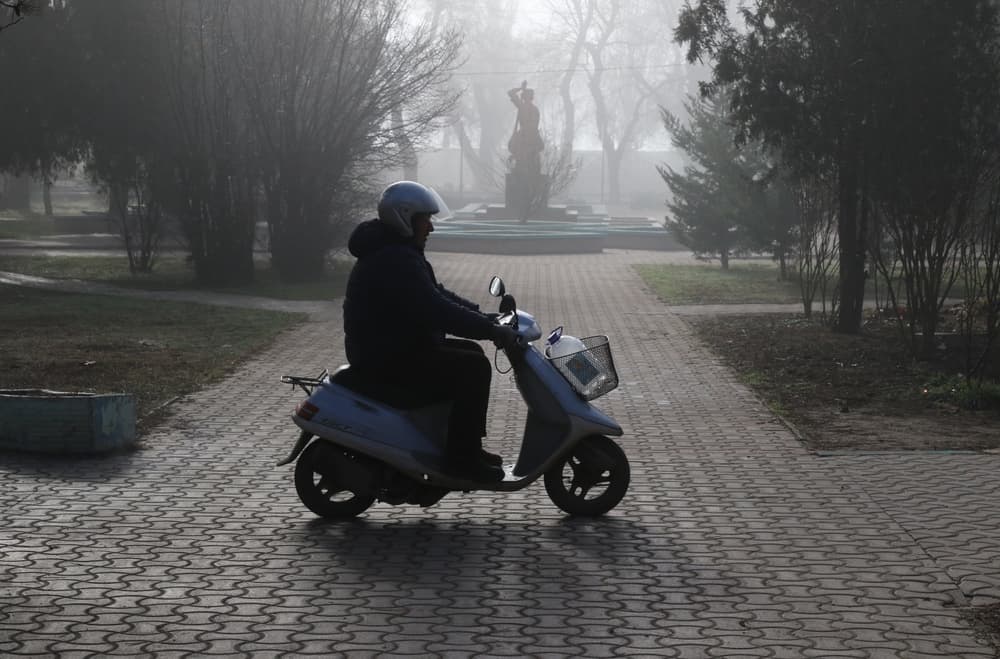
Sevastopol (AsiaNews) – The Russian authorities in Crimea have declared war on motorbikes, mopeds and other ‘noisy’ vehicles. The governor of Crimea, Sergei Aksenov, who is under Moscow’s control, has banned their use at night, claiming they interfere with Russian military operations aimed at shooting down Ukrainian drones, and these vehicles are now being confiscated en masse. Crimea.Realities reports on the attitude of the Russian authorities and military towards the use of motorbikes by Crimeans.
Between May and June, Ukrainian defence forces significantly stepped up attacks on Russian military and logistical installations in Crimea. Local Russian authorities acknowledge that, under the current circumstances, air-raid alarms and sirens must sound 22 hours a day. The Russian authorities are forced to bolster mobile fire-fighting teams to repel these attacks.
The situation in the civilian sphere is also deteriorating, and against this backdrop new restrictions are being imposed on civilians: in June, Aksenov signed a decree banning the use of motorbikes in the region during the evening and night-time hours, from 10 pm to 6 am. Specifically, a temporary restriction has been imposed on the use of motorbikes, mopeds, pit bikes, quads, scooters and other motorised vehicles.
The decree states that the main aim of these measures is “to ensure public safety and the protection of military personnel, key government infrastructure and special facilities”.
The day before, Aksenov’s adviser, Aleksandr Talipov, who assists the Russian secret services in imposing an iron fist on Crimean residents, had asked the Russian media to publicise a similar restriction, claiming that “the shrill sounds of mopeds are distorted and our mobile firefighting teams, operating in plain sight in the sky, hear a distant echo, which makes it difficult to identify a real drone. I call on the traffic police to take the strongest possible action’.
The directive has led to over a hundred administrative fines being issued against motorbike owners, and the security forces have also begun confiscating these vehicles en masse.
In a single day, 17 June, the Russian police in Crimea reported 181 traffic offences involving motorbikes; 37 of the vehicles were being ridden by people without a licence, 28 of whom were minors.
The police also state that, during checks, Crimean traffic police officers seized 59 motorbikes and impounded them in designated depots. Everyone is aware that the situation is literally getting worse by the day, and Aksenov himself, disappointed by the Russian Ministry of Defence’s failure to bolster its deterrence capabilities against attacks by the Ukrainian Armed Forces, has personally taken on the task of strengthening the BARS-Crimea unit under his control, with a particular focus on increasing the number of mobile firefighting teams.
Another adviser to the Russian head of Crimea, Vladimir Mertsalov, confirms that “the current objective is to deploy as many mobile fire teams as possible, so that the vehicles can move quickly and respond promptly to threats”, with the aim of creating a multi-layered defensive line to counter air attacks. Currently, electronic warfare systems no longer work against long-range drones, so they can only be intercepted.
Mobile fire teams were spotted near railway stations in Crimea in June, appearing when the Ukrainians began striking Russian military convoys on the railway, as well as Russian railway logistics.
The effectiveness of these reinforced mobile fire teams is still difficult to assess, and the Ukrainian Defence Ministry claims to be able to penetrate the Russian air defence system in Crimea, and in other Ukrainian territories occupied by Russia, ‘with almost no losses’. The Russian authorities and their military command, of course, do not publicly disclose this information.