








‘I, an Algerian woman born in the years of terror and these days with Pope Leo’
The pontiff leaves Algeria today to travel to Cameroon, the second stop on his apostolic journey to Africa. The testimony of a young woman who grew up in Italy and chose to be present in Algiers to experience this historic event alongside her people. “In the crowd, everyone was saying: it’s a sign of unity between Christians and Muslims. We’ve seen that change happens in a subtle but real way.”
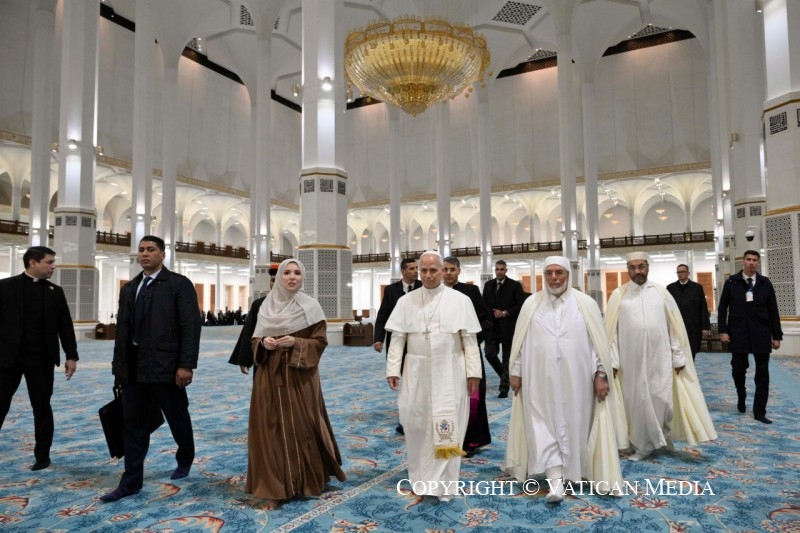
Algiers (AsiaNews) - Pope Leo XIV is leaving Algiers this morning to head to Cameroon, the second stop on his apostolic journey to Africa. He does so after two intense days that have left a deep impression on the Algerian people. This is recounted in the testimony sent to us by Miriam Hassina, a young woman of Algerian origin who grew up in Italy, who traveled from Milan to the country of her roots these past few days to experience the Pope’s visit firsthand among the people of Algeria.
Two months ago, when a dear friend told me that the Pope would begin his apostolic journey to Africa by departing from Algeria, I found it hard to believe. For someone like me, born during the so-called “black decade”—marked by the terrorism of the 1990s—the idea that, thirty years later, a Pope would arrive in Algiers seemed almost unthinkable.
I was born in Algeria but grew up in Milan, where my parents met and built their lives. For a long time, the country of my origins remained more of a distance than a place, partly due to the difficulties associated with obtaining visas. This time, however, it was different: the significance of the event made it hard to stay away.
So I decided to go. Even if only for three days. Already at the airport, I sensed an unusual atmosphere, one of preparations and anticipation, similar to that which precedes the arrival of a relative from afar.
Once in the city, this impression was confirmed. The cleaned-up streets, the spruced-up neighborhoods, and the enthusiastic accounts of those living in Algiers painted a picture of a city ready. It was not merely a matter of welcoming an official visit, but someone long-awaited.
Along the main streets, kilometers of Holy See flags fluttered alongside Algerian ones, a message of unity impossible to miss. Security was extensive, with thousands of police and military personnel present: rather than tension, one sensed a shared desire for everything to go as smoothly as possible.
From his very first gestures, Pope Leo XIV set the tone for the visit. His decision to visit the Maqam Echahid, the monument to the martyrs of the 1962 War of Independence, was seen as a sign of deep respect for the country’s history. Even more significant was his opening greeting, “As-salamu alaykum”—peace be with you.
The entire day was framed by heavy rain, unusual for Algiers. The streets were flooded, movement slowed, but the rain did not disperse the crowd. On the contrary, it highlighted their determination.
Heading up toward Notre-Dame d’Afrique, the basilica that overlooks the city and hosted the day’s final event, one encountered groups of young pilgrims, soaked but determined to reach their destination. Hundreds of people were waiting for the Pope: Algerians, foreign workers, and students from various African countries.
When asked why they were there, the answer was strikingly simple: “This journey is a sign of unity between Christians and Muslims.” Words that, in the Algerian context, take on a special meaning. The decade of violence between 1992 and 2002 deeply scarred the country, with thousands of victims, both Muslim and Christian, including the nineteen martyrs beatified in Oran in 2018.
Although the heavy rain tested everyone’s patience, no one seemed willing to leave. Everyone had a reason for being there: some had come from distant regions of Algeria; Muslims invited by Christian friends and colleagues; others who simply did not want to miss what they perceived as a historic occasion.
Many, including myself, remained outside the Basilica, unable to fully follow the Pope’s words due to the weather and technical issues. Yet this did not diminish the significance of what we were experiencing.
What emerged most clearly is that, in a country marked by a complex history like Algeria, this day offered a glimpse of something essential: change happens over time, often quietly, but it is real.
When I was born, all of this was difficult even to imagine. Today, however, I witnessed it.

.png)










