While the phone call between Trump and Xi Jinping is attracting the world's attention amid the Sino-US trade war, Beijing is moving forward with a project for large free trade zone on its southernmost island. To attract foreign investment, it is also launching a pilot project for direct access to the global Internet for authorised users and under state control.
The visa restrictions announced by the White House particularly affect Chinese students, who now number 277,000 in the United States. However, their numbers had already been declining in recent years, with the growth of alternatives in Asian universities, particularly in Japan, South Korea and Singapore. While Chinese universities are climbing the rankings in technological disciplines, they suffer from limitations on freedom of thought in the humanities.
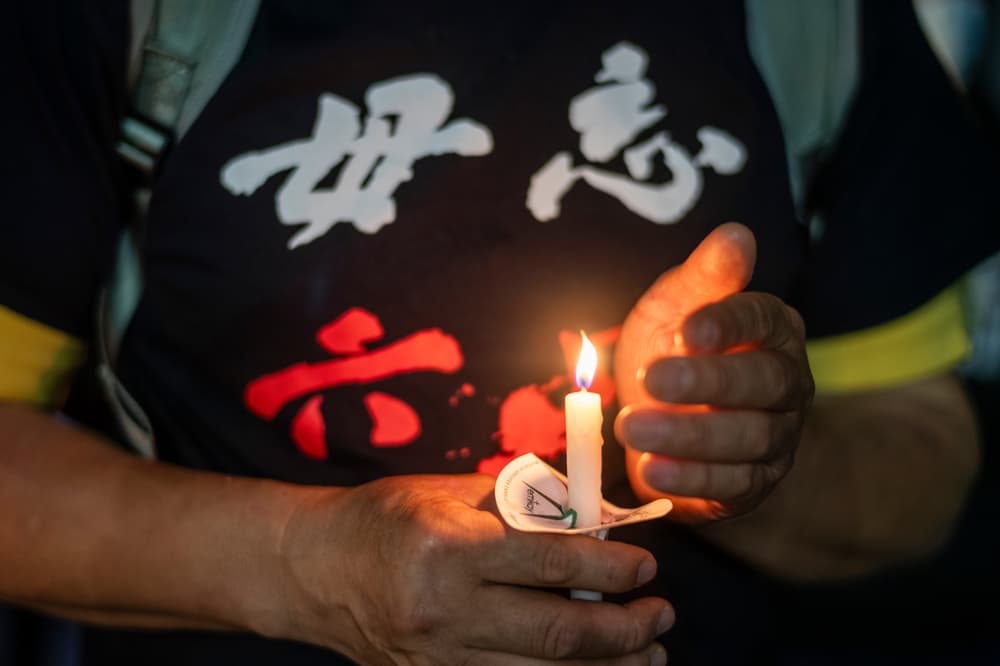
On the eve of the 36th anniversary of the Tiananmen massacre, Hong Kong authorities have sealed off Victoria Park again, once the venue for a memorial vigil for the victims until 2019. Meanwhile, the CHRD released a list of 32 people detained for refusing to be silent about those events, including six in mainland China who were direct participants in the events of 1989.
About 30 countries have signed the convention establishing the IOMed, a new international organisation promoted by China for conflict mediation in a city on its way to be “normalised”. The new body reflects a version of multilateralism that is tailored-made for Beijing, which has ignored rulings by UN tribunals. This brings to mind the words of Chow Hang-tung, a lawyer jailed for her pro-democracy beliefs, on the effect of the emptying words like rights, democracy and peace of their meaning, in Hong Kong and beyond.
In the race with Washington for dominance in this crucial sector, Beijing has now introduced new educational guidelines aimed at equipping students with the ability to design algorithms by the time they reach secondary school. Rather than solely focusing on developing the most advanced technologies, China aims to win this global competition by cultivating a society that can fully harness the potential of these tools.
In his first Regina Caeli, from the window of the Apostolic Palace, Pope Leo XIV cited the Day of Prayer for the Church in China celebrated yesterday and the tenth anniversary of the publication of the encyclical Laudato Si', noting Pope Francis's appeal "to listen to the twofold cry of the Earth and of the poor." This afternoon, the new pope will be installed in St John Lateran as the bishop of Rome.
Today we celebrate the Day of Prayer for Christians in China, instituted by Benedict XVI on the feast of Our Lady of Sheshan. This is an opportunity to celebrate communion with the Church in China but also to remember its sufferings. Speaking to AsiaNews, an underground priest explains the actual problems involved in joining the Patriotic Association that Beijing is trying to impose with increasing harshness in the wake of the 2018 Agreement with the Holy See.
With China’s demographic crisis deepening, local authorities are ramping up subsidies and even sending mass text messages to promote marriage and family planning among young people. Yet results remain poor: in the first three months of 2025, marriages dropped by a further 8%. Rather than turning to government-backed dating apps and websites, young single Chinese prefer using video chats to find a potential partner.
Opened in 2019, the futuristic Beijing Daxing International Airport continues to expand as the "new gateway to China". But hundreds of residents forced to leave their villages to make way for the structure have found themselves with homes that are smaller than they were promised. Now they are mobilising for compensation based on the market value of their lost properties.
Hong Kong’s Card Stephen Chow said that the pope told him that he “visited China several times and got to know the Chinese culture and reality.” This is unprecedented for a pontiff, linked to his long mandate as prior general of an order that, at the behest of Leo XIII (the pontiff whose name the new pope took) sent its own missionaries and bishops in Hunan until the expulsion decreed by Mao. Starting in the 1980s, the order rebuilt ties and presence in the Diocese of Changsha through the province of the Philippines.
How will the new Pope manage the relationship between Beijing and the Vatican? The faithful in mainland China hope that the bishops to be appointed and approved under the agreement will truly love the faithful and know their flock. That they will be skilled in pastoral care and enjoy the support of the faithful. Only in this way will a bishop be able to guide the faithful to love both their country and the Church.
Tomorrow is the anniversary of the abduction by Chinese authorities of the child designated as the reincarnation of the second-highest Tibetan Buddhist authority. This comes as concerns grow about possible interference in the succession of the Dalai Lama who is set to celebrate his 90th birthday shortly. Meanwhile, Tibet Radio was born in exile to fill the void left by the closure of the Tibetan-language service at Radio Free Asia and Voice of America.
Chinese concerns over its army of subcontractors in the garment industry working for big brands is behind the first truce in the Sino-American trade war. The China Labour Bulletin reports protests and closures in April. Local authorities are trying to limit the damage with informal mediation, hoping for a recovery. Facts contradict statements by Western brands about “responsible exits”.
A source in mainland China spoke to AsiaNews about the election of a pontiff born in a country that, according to state propaganda, is its archfoe against whom to flaunt China’s superiority. Yet, the open gaze of Chinese Catholics towards Leo XIV shows, once again, that believing is freedom, and that a Chinese does not become Catholic if they have not first accepted, internalised, and then freed themselves from the “international tensions” that this entails.
On the occasion of the conclave, the Chinese Catholic website has retraced the historical origins of the term jiaohuang, used to refer to the Pope. It was first introduced by the great missionary Giulio Aleni in his 1623 geography treatise Record of Foreign Lands. More recently, however, the Catholic community has also begun promoting the term jiaozong, which is seen as more aligned with the spiritual role of the successor of Peter.
The local government is asking the Legislative Council (which it controls) to approve a new regulation that would hand over jurisdiction to mainland China in "complex cases" involving foreign countries. The measure appears tailored to the case of Jimmy Lai. The "geopolitical situation" is cited as justification. It was opposition to extradition that sparked the pro-democracy protests in 2019.
During Chinese President Xi Jinping’s three-day visit to Moscow, the "Power of Siberia-2" gas pipeline—vital to Russia’s economy—was once again a topic of discussion. Beijing is already supporting Russia’s expanding military production by supplying microelectronic components blocked by Western sanctions. The presence of Chinese soldiers in the parade before Lenin’s mausoleum also reflects internal political considerations within China.
As with the death of Pope Francis, the Catholic entities controlled by the Communist Party of China kept publicly within diplomatic boundaries, unlike Catholic communities who were joyful for their new pastor. The issue of the two bishops elected in recent weeks will be the first test for the new pontiff. In a statement, Taiwanese President Lai expressed hope that his country and the holy See can promote peace and justice together.
In the era of tariffs, stimulating domestic demand is vital for Beijing. But consumption is growing slowly—and it is no longer the megacities driving it, but smaller cities, where wages and confidence in the economy are rising. These shifts may also bring about broader social changes.
A 65-year-old Jesuit, he has led the Catholic community of the great metropolis for more than three years, putting the challenge of unity and education of young people first in a difficult social context after the events of 2019. He knows the dioceses of the People's Republic of China well, having already made three official trips to Beijing, Guangdong and Shanghai.
Sources told AsiaNews that local priests were summoned yesterday to ratify the choice of Fr Wu Jianlin, vicar general. Another election was held in the Diocese of Xinxiang, in Henan, whose underground bishop has been arrested several times. During the sede vacante period, Beijing is reiterating the autonomy of the Church in China to test Francis’s successor over the agreement.
A source talked to AsiaNews about how Chinese Catholics are coping with Francis’s death. Remarks and pictures abound on local social media. “Amid the sorrow and mourning, the joy of announcing love prevailed,” as “a spontaneous explosion, not very cautious, but conscious that death and fear are not the last word.” An elderly lady and the Pope shared an “impossible dream”: she wanted to visit the Vatican, while he wanted to visit China.
On a visit to the archbishop’s residence, the president bowed three times before the pope’s picture. A Taiwanese delegation will travel to Vatican City led by former Vice President Chen Chien-jen, a Catholic. Meanwhile, three days after the pontiff’s death, the Patriotic Association posts a statement on his death, calling for prayers.
Answering a journalist's question, a Foreign Ministry spokesperson praised “constructive contacts and engaged in useful exchanges” between China and the Holy See. But, in the name of sinicisation, the reference is to state-to-state relations, not the local Catholic community. The presence of Chinese bishops at Francis’s funeral is an open question.
The Xinde Catholic website has widely reported Francis’s death. So far, no word has come from President Xi Jinping, the Chinese government, nor the Patriotic Association. The Diocese of Hong Kong remembers the pontiff’s trip to Mongolia and his attention for relations between the Vatican and China.
The funeral of the PIME missionary, a pioneer of dialogue with the Church in China after Mao’s persecution, was held today. In his last book, he told the story of one of his first trips to the Chinese capital where he met with some elderly people forced to quit the religious life. They understood that he was a priest, and asked him to bless some sacred images. He was moved when he bid them goodbye.
The incident took place on 23 March in the Diocese of Lüliang, but the authorities tried to hush it up. The intervention of special forces attracted other Catholics from the nearby village of Xinli, home to an old Catholic community. An officer was also wounded in the incident. The parish priest and some parishioners were arrested. The community was forced to engage in "self-criticism", but the increasingly inflexible rules on religions are the real problem.
The PIME missionary died just before his 100th birthday. He was a pioneer in establishing contact with Catholics in China after the Cultural Revolution and founder of the Holy Spirit Study Centre in Hong Kong, for decades the most documented study centre on the Catholic Church in China. Like Matteo Ricci, he followed the path of friendship and dialogue to share the Gospel of peace with the Chinese people.
Again this year the bishop who refuses to join the Patriotic Association was taken away on the eve of Holy Week. Already at Christmas he was subjected to serious retaliation for having celebrated the opening of the Jubilee in the diocese of Zhejiang, where the Beijing authorities have put a priest ‘loyal’ to the Party in leadership.
The strategic infrastructure in the south-west had a makeover thanks to Chinese support. For Prime Minister Hun Manet, the country will not allow foreign military bases on its territory, but is open to Chinese aid. Chinese President Xi Jinping is expected to visit the country to promote China as the only reliable partner for the region, taking advantage of US disengagement and Trump's tariffs.